
With the first half of 2026 gone, it’s time for a southern Missouri housing market update — broken down by three regions that I cover: the Springfield metro, greater Branson, and West Plains & the rural Ozarks.
(I’m using the same definitions here that I used in my article The Best Time to Sell Your House in Springfield, Branson, and West Plains: The “Springfield metro” is defined as Greene, Christian, Webster, Polk, and Dallas counties; greater Branson includes Stone and Taney counties; and West Plains & rural Ozarks is defined as Howell, Oregon, Ozark, Shannon, Texas, and Wright counties.)
Note: All data reflects publicly available sales from the first half of 2025 & 2026 and is for informational purposes only. You won’t see sales prices here, because Missouri is a non-disclosure state — that data isn’t publicly available under state law.
Southern Missouri Housing Market Update — High-level 2025 vs 2026
Every region I cover saw more homes change hands this year than last — but not by the same margin.
Just showing the number of homes sold in the first half of 2026 won’t tell you a whole lot.
Because for context, you need to also see sales data from the first half of the previous year (the corresponding period).
So, here’s the high level data for southern Missouri’s three regions that I cover, again comparing homes sold in the first half of 2026 to homes sold in the first half of 2025:
- Springfield metro: ~4% more homes sold
- Branson: ~8% more homes sold
- West Plains & rural Ozarks: ~15% more homes sold
Southern Missouri Housing Market Update — A Further Breakdown
Bedroom count is usually the first filter buyers apply.
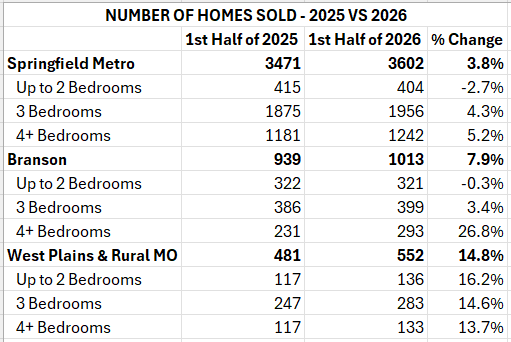
Here’s how first-half 2026 activity compares to the same period last year, by bedroom count:
- 2 bedrooms or less (so, studio/loft apartments, 1-bedroom condos, and 2-bedroom condos or houses are included in this group);
- 3 bedrooms; and
- 4 bedrooms or more
What’s Driving Each Region
The Springfield metro grew 3.8% — the smallest increase of the three.
Part of the reason: Springfield (and Branson, too) didn’t slow down as much last year. So, they had less ground to make up. Growth here also favored bigger homes. Sales of 3-bedroom and 4+ bedroom homes both rose. Sales of smaller homes dipped slightly (-2.7%).
Branson’s 7.9% headline number hides some of the story.
Sales of Branson area 4+ bedroom homes jumped nearly 27% — the sharpest increase of any category, in any region, this year. Meanwhile, smaller-home sales stayed flat (-0.3%). Right now, buyers favoring big homes are driving this market.
West Plains & the rural Ozarks paint a different picture.
This region’s real estate cycle usually lags behind the more populated markets. Last year, it saw the softest activity of the three. So, this year’s 14.8% jump is partly a rebound from a smaller base. One more thing to note: sale counts here are lower to begin with, so percentage swings look bigger than they would in Springfield or Branson.
Unlike the other two regions, West Plains grew evenly across every home size — 2 bedrooms or less (+16.2%), 3 bedrooms (+14.6%), and 4+ bedrooms (+13.7%). No single size was the main driver of growth.
So, What Does All This MO Housing Market Data Mean?
In short, it’s a growing market.
More buyers. More sellers.
Local sellers often turn into local buyers after they sell their home. Of course, that’s not always the case (for example, sellers could be moving in with family, into a rental or a senior living facility, or they could be moving out of the area).
So, in summary for this mid-year 2026 southern Missouri housing market update: All three regions are trending in the same direction. More homes are changing hands than this time last year… even with mortgage rates holding above 6% through the first half of 2026.
This year’s first half was a solid start to the year across southern Missouri.
