

Mortgage Math Stinks, but You Can Still Save Money When Mortgage Rates are High
Looking to somehow save money when mortgage rates are high?
That’s not possible, right? Not in this bloodbath of a housing market right now…
Mortgage rates are pushing closer to 8%. And we’re seeing headlines like “Refinance demand grinds to a halt as rates hover near three-year highs” and “Banks seize 42% more homes as Americans fall behind on mortgages.”
Just look at the mortgage math: Same house, same loan, $2,256 more per year.
That’s what a 7.28% mortgage rate costs on a $300,000 mortgage compared with the 6.34% buyers got a year ago. About $188 more every month. And it’s why buying a house in Springfield, MO when mortgage rates are high takes a plan.
Here are 6 ways to save money when mortgage rates are high:
- Widen your search: If you’re considering one of the pricier suburbs, check out a more affordable suburb or parts of Springfield. On a median-priced home, the suburbs cost about $320 to $790 more per month than Springfield.
- Use the market data to negotiate: At a 7% mortgage, each $10,000 less you pay will save about $68 per month. Some homeowners will be open to a lower offer price. You’ll just need to know if you have negotiating room, which a real estate agent can help with.
- Ask the seller for concessions: A seller-assisted 2-1 buydown on a $269,000 loan cuts the first-year payments by about $350 per month.
- Pick the loan carefully: VA 7.10%, FHA 7.13%, conventional 7.46% as of Oct. 5th.
- Shop lenders: Each quarter-point is worth about $45 per month on a $269,000 loan.
- Plan to refinance, just don’t NEED to do it ASAP: A 1-point drop saves about $179 per month on a $269,000 loan.
Good News for Buyers: Springfield, MO Homes for Sale are Back to 2019 Levels
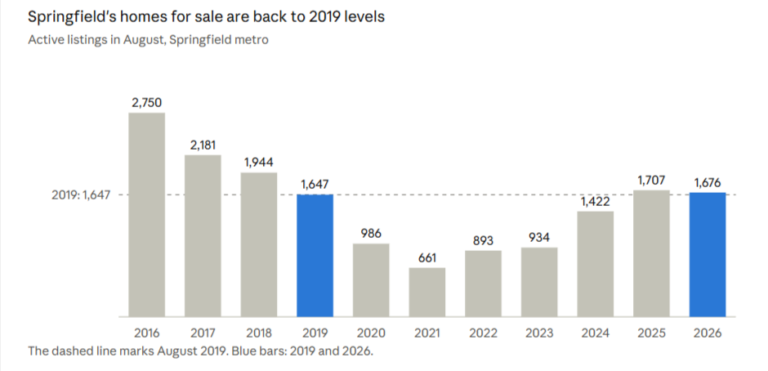
Springfield had 1,676 homes for sale in August, according to Realtor.com data on the Federal Reserve Economic Data (FRED) website.
That’s about the same as August 2019 (1,647) and up from a low of 661 in August 2021.
It’s still below the 2016 to 2018 levels, when the metro had between 1,944 and 2,750 homes for sale in August.
More homes for sale gives buyers more choice and more room to negotiate.
How a 7% Mortgage Rate Affects a Springfield Budget
Redfin notes Springfield’s median sale price is about $220K in August. So, that’s a useful reference point for the city that you can see in the chart below.
Redfin’s data has the median sale price at $269,000 in Greene County, which includes Springfield, Republic, Willard, and other towns. And at $328,800 in Christian County, which includes the popular suburbs of Nixa and Ozark.
The figures leave out taxes, home insurance, and mortgage insurance (if required), and they are my calculations from Freddie Mac’s weekly averages.
Your rate will depend on your credit, down payment, and loan type.
But overall, the jump from last year’s average 6.34% mortgage rate to today’s 7.28% adds over $100 — and sometimes nearly double that — to a monthly payment.
Here’s the principal and interest on a 30-year loan at each rate:
| Loan amount | At 6.34% (a year ago) | At 7.28% (now, mid-October 2026) | Difference |
|---|---|---|---|
| $220,000 (Springfield median, Redfin) | $1,367 | $1,505 | +$138 |
| $250,000 | $1,554 | $1,711 | +$157 |
| $269,000 (Greene County median, Redfin) | $1,672 | $1,841 | +$169 |
| $300,000 | $1,865 | $2,053 | +$188 |
| $328,800 (Christian County median, Redfin) | $2,044 | $2,250 | +$206 |
The other way to view this change is difference in buying power.
A home buyer’s budget of $2,000 per month for principal and interest supports a loan of about $322,000 at a 6.34% mortgage rate.
But at a 7.28% mortgage rate, that same $2,000 monthly budget only buys a $292,000 house. So, for the same payment, a buyer may not get the neighborhood and house that they truly want.
Strategy #1 to Save Money When Mortgage Rates are High: Widen Your Search
Where you buy has a big impact on how much you’ll pay.
Redfin’s August data showed a wide spread in prices and in how quickly homes sell (which I’ll cover more in-depth in my upcoming Springfield suburbs comparison article):
| Town | Median sale price | Days on market | Principal and interest at 7.28% on the full price |
|---|---|---|---|
| Springfield | $220K | 15 | $1,505 |
| Willard | $267K | 25 | $1,827 |
| Republic | $272K | 30 | $1,861 |
| Nixa | $325K | 20 | $2,224 |
| Ozark | $335K | 31 | $2,292 |
The payment column finances the whole price, to show the difference. The gap between Springfield and Ozark is about $787 per month. Willard and Republic cost roughly $320 to $355 per month more than Springfield, and Nixa and Ozark cost over $700 more.
Two takeaways for a buyer on a tight budget:
- Springfield is the lowest-priced option, but homes go fast. Expect to move quickly on a home you like, and have your financing lined up.
- Willard and Republic are generally the most affordable Springfield suburbs. Republic’s homes took 30 days to sell and its median price was down year over year. A home in Republic may give you more room to negotiate than in Nixa, for example, where prices were up and homes sold in 20 days.
Within any town, a smaller home, an older home, or one that needs updates can cost far less than the median.
Strategy #2 to Save Money When Mortgage Rates are High: Use Springfield’s Market Data to Negotiate
You can’t control mortgage rates. But you can control the price you pay.
Springfield’s numbers show where there is room:
- Price cuts are common. About 35% of Springfield listings had a price cut in August. And in 2023 through 2025, houses with a price cut were around 40% from June through October. A home that has already been reduced shows a seller who is motivated.
- Homes that have sat give you more room. Redfin’s median Springfield home went pending in about 15 days in August. So, a listing that has been up for much longer has already outlasted most. I’ll explain more in my upcoming Springfield negotiating post.
- Fall and winter favor buyers. Pending sales are about 35% below their spring level in winter. And winter listings sit about 60 days versus about 42 in spring and summer. Fewer competing buyers is an advantage when you are the one asking for a lower price. My upcoming seasonality post has the monthly detail.
A lower price helps more than it may seem. At a 7.28% mortgage rate, each $10,000 you negotiate off a loan saves about $68 per month in principal and interest.
Strategy #3 to Save Money When Mortgage Rates are High: Ask the Seller to Help with Closing Costs
A lower price isn’t the only way to lower what you’ll pay.
A seller can also credit you money toward closing costs or a rate buydown. Each loan type caps how much, based on seller concession rules:
| Loan type | Seller can contribute up to |
|---|---|
| Conventional, less than 10% down | 3% |
| Conventional, between 10%-25% down | 6% |
| Conventional, 25% or more down | 9% |
| FHA | 6% |
| VA | Normal closing costs with no cap, plus 4% in concessions |
On a $269,000 home bought with less than 10% down, a conventional loan lets the seller contribute up to $8,070. The credit has to go toward actual closing costs. It can’t come back to you as cash.
In a high rate market, sellers can help buyers with discount points, which will lower the rate for the life of a fixed-rate loan. Or sellers can fund a temporary rate buydown.
A 2-1 buydown lowers a borrower’s locked-in base rate by 2% (two points) in the first year and 1% (one point) in the second year. And then the borrower’s rate returns to the full locked-in rate in year three. On a $269,000 loan at 7.28%, that 2-1 buydown costs about $6,350 and cuts the payment by about $350 per month in year one and $179 in year two.
Note that a temporary buydown lowers your early payments but not your long-term rate.
So, it works best if you expect to refinance or your income to rise. Or both.
Strategy #4 to Save Money When Mortgage Rates are High: Pick Your Loan Carefully
Your loan choice changes your rate, your upfront cash, and your monthly insurance.
Optimal Blue’s October 5th averages for 30-year fixed loans, published on FRED as VA and conforming indices, show:
| Loan | Average rate | Main trade-offs |
|---|---|---|
| VA | 7.10% | Veterans and service members only. No PMI, no down payment, and a funding fee |
| FHA | 7.13% | Easier credit and down payment rules, with mortgage insurance premiums |
| Conventional | 7.46% | PMI under 20% down. Best with strong credit and a larger down payment |
If you’re a veteran, I’ll cover the details in my upcoming VA loan guide (November 2026).
Adjustable-rate mortgages. A 5/1 ARM starts at a lower rate than a 30-year fixed loan. Bankrate’s national average 5/1 ARM APR was about 6.42% in early October. The risk is that the rate can rise after the first five years. So, an ARM suits a buyer who expects to sell or refinance before then, not one who needs a payment that never changes.
Missouri down payment help. The Missouri Housing Development Commission’s First Place program offers below-market rates to first-time buyers and qualified veterans. It also offers an optional second loan worth 4% of the mortgage for down payment and closing costs. That second loan is forgiven if you stay in the home and keep the loan for 10 years. Income and purchase price limits apply, and the loan has to go through a certified lender. MHDC’s Next Step program has higher income limits and is open to repeat buyers.

Strategy #5 to Save Money When Mortgage Rates are High: Shop Lenders and Manage the Rate Lock
With rates this high, a small difference between lenders can save you some money.
On a $269,000 loan, each quarter-point is worth about $45 per month.
- Get loan estimates from at least three lenders on the same day. Compare the rate, the APR, and the fees side-by-side. Note that a lower rate can come with higher fees.
- Improve what you control before you apply. Pay down credit card balances, avoid new debt, and check your credit report for errors. A better score can move your rate.
- Ask how the lock works. A rate lock holds your rate until closing. Ask how long the lock lasts, what an extension costs, and whether the lender offers a float-down option, which lets you take a lower rate if rates fall before you close.
- Match the lock to your closing date. Lock once you have a contract and a realistic closing timeline. A lock that expires before closing can leave you exposed.
- Get pre-approved, not just pre-qualified. A pre-approval letter shows sellers you can close, which matters in a market where well-priced homes go pending in about two weeks.
Strategy #6 to Save Money When Mortgage Rates are High: Plan to Refinance Later, Just Don’t NEED to do So ASAP
Some people in real estate love to say: “marry the house, date the rate.”
The idea is to buy now and refinance when rates drop. It’s catchy, but it skips the part where breaking up with your rate means more closing costs and a new loan application.
A refinance can work out. But treat it as a bonus, not as a must-have within a certain time.
- Buy a payment you can afford at today’s rate. If rates fall, a refinance adds savings over time. If rates don’t, you’re still fine with the monthly payment.
- Know your break-even number. Divide the refinance’s closing costs by the monthly savings. On a $269,000 loan, dropping from 7.28% to 6.28% saves about $179 per month. So, $5,000 in refinancing closing costs will take you about 28 months to recover. That’s an illustration, so ask lenders for real numbers.
- Be careful with discount points. Points lower your rate, but they only pay off if you keep the loan long enough to recover their cost. If you expect to refinance in a couple of years, it may be a poor fit.
- Check for a prepayment penalty. Most mainstream loans don’t have one, but your loan estimate will say.
- Check whether your loan has a streamline refinance. VA loans can use an Interest Rate Reduction Refinance Loan (IRRRL), and FHA loans can use an FHA Streamline Refinance. Both usually involve less paperwork and often skip the appraisal. But you can only use them if you already hold that type of loan. A conventional loan generally needs a full refinance.
Rates were 6.34% a year ago and 7.28% now. They move both ways, and no one knows when exactly which direction mortgage rates will go and when.
Frequently Asked Questions About How to Save Money When Mortgage Rates are High
Should I wait for rates to drop before buying in Springfield?
No one knows when or whether rates will fall, and waiting has its own costs. Home prices in the Springfield metro rose about 4% over the past year, according to the Federal Housing Finance Agency’s index, so a lower rate could be offset by a higher price. If you buy now, budget for today’s rate and treat a later refinance as a bonus.
How much does a one-point rate change affect a payment?
On a $269,000 loan (the median price of Greene County, Missouri, and this is admittedly simplifying things with no money down), going from a 7.28% mortgage rate to 6.28% lowers the principal and interest payment by about $179 per month.
When is the best time of year to buy in Springfield?
Fall and winter tend to favor buyers. Price cuts are most common from June through October. And in winter, pending sales are about 35% below their spring level, so there is less buyer competition.
Can a seller really pay my closing costs?
Yes, within the limits for your loan type: 3% to 9% on conventional loans depending on your down payment, 6% on FHA, and on VA loans normal closing costs plus 4% in concessions.
Limits
- Rates vary by borrower. The figures here are national averages. Your rate depends on your credit, loan type, down payment, and the lender.
- The payment examples are illustrative. They cover principal and interest only and are my calculations.
- The local data is from a few sources. Redfin’s August figures and Realtor.com’s monthly counts differ in method and geography, so compare direction, not exact values.
- Rules change, and this is general information. It’s not financial advice or a loan offer, so confirm program details and rates with a licensed lender.
Sources
- Freddie Mac, Primary Mortgage Market Survey (Oct. 1, 2026)
- Optimal Blue via FRED, VA and conforming 30-year fixed indices
- Redfin, Springfield, MO housing market (August 2026)
- Redfin, Greene County, MO housing market (August 2026)
- Redfin, Christian County, MO housing market (August 2026)
- Federal Housing Finance Agency via FRED, All-Transactions House Price Index for Springfield, MO
- Fortune, Seller concessions: what they are and how to use them
- Missouri Housing Development Commission, First Place program