If you’re thinking about moving to the Ozarks, you’re not alone.
More and more people are leaving high-cost states to start fresh in southern Missouri and northern Arkansas. I moved to the Ozarks myself just over a year ago. And I can tell you firsthand — the Ozarks are the real deal.
The Rockies get the postcards. The Appalachians get the documentaries.
But the Ozarks? They get the people who actually did their homework.
Rolling hills, clear rivers, affordable homes, and a slower pace of life — all without giving up access to good healthcare, decent roads, and a strong sense of community.
This article covers everything you need to know before moving to the Ozarks in 2026.
I’ll walk you through the cost of living, the best towns to consider, what the weather is really like, and some honest pros and cons. Whether you’re a retiree looking for lake living, a remote worker ready to ditch the city, a separating or retiring military veteran looking for more land and freedom, or a family who wants more space for less money — this article on moving to the Ozarks is for you.
In this moving to the Ozarks article, we’ll cover:
- What Are the Ozarks?
- Why Are People Moving to the Ozarks?
- Cost of Living When Moving to the Ozarks
- Best Places to Live When Moving to the Ozarks
- Pros and Cons of Moving to the Ozarks
- What to Know Before Moving
- Is Moving to the Ozarks Right for You?
- Frequently Asked Questions About Moving to the Ozarks in 2026
- Is moving to the Ozarks actually affordable in 2026?
- Where do most people moving to the Ozarks choose to live?
- What is the cost of living like for those moving to the Ozarks?
- Is the Ozarks a good place to retire?
- What is the weather like in the Ozarks?
- Is internet reliable in the Ozarks?
- Are there job opportunities in the Ozarks?
- Go Deeper
- Final Thoughts
- Recent Articles
What Are the Ozarks?
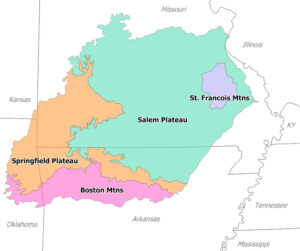
The Ozarks are a large highland region that stretches across southern Missouri and northern Arkansas (with smaller parts reaching into southeastern Kansas and northeastern Oklahoma). The region sits on an ancient plateau — one of the oldest landforms in North America.
For about 12,000 years, the Osage Nation called this land home. In the early 1800s, settlers of Scots-Irish, English, and German descent arrived from Appalachia. They brought small farming traditions that, in many ways, still shape the culture of the region today.
The Ozarks are known for:
- Rolling hills covered in hardwood forest
- Clean, spring-fed rivers and lakes
- Some of the most abundant groundwater in the country
- A deep tradition of self-reliance and community
Today, popular areas for people moving to the Ozarks include Branson, Springfield, and West Plains in Missouri — and Harrison, the Mountain Home-Bull Shoals area, and Cherokee Village-Horseshoe Bend area in Arkansas. We’ll cover each of these in detail below.
For a deeper look at the region’s history and geography, see our article on what the Ozarks actually are.
Why Are People Moving to the Ozarks?
There are three big reasons people pack up and head to the Ozarks: cost of living, natural beauty, and a slower pace of life. Let’s look at each one.

1. A Lower Cost of Living by Moving to the Ozarks
This is a major reason for moving to the Ozarks. People are tired of paying California, Florida, or Texas prices for housing — and they’ve done the math. Moving to the Ozarks makes sense for their wallets.
Let’s start with housing.
In 2026, the U.S. median home price is $400,000.
In Missouri, it’s $270,000.
And in Arkansas, it’s $240,000.
That’s a massive difference.
Gas is also cheaper in the Ozarks than in most of the country.
The region sits close to Gulf Coast refineries — and even closer to refineries along the Mississippi River and in southern Arkansas. Lower fuel costs mean lower prices on nearly everything!
2. The Ozarks’ Natural Beauty and Outdoor Living
The Ozarks are an outdoor lover’s playground. I’m not exaggerating. The water alone is worth the move.
The region is home to some of the clearest rivers in the Midwest — the Current River, the Buffalo National River, and the White River, just to name a few. And the lakes here are legendary: Table Rock Lake, Norfork Lake, and Bull Shoals Lake draw boaters and anglers from all over the country.
If you love the outdoors, the Ozarks give you:
- Hiking and backpacking in the Mark Twain National Forest and the Ozark National Forest
- World-class trout fishing on the White River and the North Fork
- Hunting for deer, turkey, and waterfowl
- Boating, kayaking, and float trips on spring-fed rivers
- Lake living with some of the best water quality in the region
And about that water — the Ozarks sit on top of enormous underground aquifers. Big Spring in Missouri, one of the largest natural springs in the world, pumps out about 286 million gallons of water per day. If you’re coming from a drought-prone western state, the Ozarks will feel like a completely different world.
3. Discover a Slower Pace of Life by Moving to the Ozarks
I’ll be honest with you — not every corner of the Ozarks is slow and quiet.
Springfield, Missouri has a metro population of over 500,000 and is growing. And if you’re on I-44 heading toward St. Louis or on I-49 in Arkansas, you’re going to hit traffic.
But outside those metro areas? Things are different. Life is quieter. There’s less congestion, less noise, and less of the low-grade stress that comes with living somewhere too big and too fast. For most people moving to the Ozarks, that’s exactly the point.
Cost of Living When Moving to the Ozarks
Housing: Maybe Your Biggest Factor When Moving to the Ozarks
Housing is where you’ll notice the biggest difference. The Ozarks is still one of the most affordable places to buy a home in the entire country.
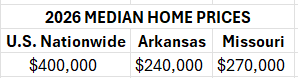
And in the rural Ozarks, you can often do even better than those state medians.
Also, let’s not forget about recent land sales. In case you want to buy land and build your dream home. Raw land in the rural Ozarks starts at roughly $6,000 per acre. (Note that this is just a summary. Pricing can vary widely, based on location, size, quality of the land, water access, etc.)
See how the Ozarks stacks up against Tennessee in our full Ozarks cost of living comparison.
Property Taxes: A Big Ozarks Plus
Property taxes in the Ozarks are low — sometimes surprisingly so.
Across the U.S., the effective property tax rate averages about 1%. In Springfield or northwest Arkansas, you’ll pay close to that.
But in the rural Ozarks, effective rates can drop as low as 0.34%. That means some homeowners can pay just a few hundred dollars in property taxes per year. And that’s on a property with acreage!
We cover property taxes in full detail — alongside crime, schools, and freedom scores — in our honest look at whether the Ozarks is a good place to live.
Income Taxes: Missouri vs. Arkansas

Both Missouri and Arkansas offer real tax advantages — especially for retirees and veterans. Here’s a quick breakdown:
Social Security Income
- Missouri: Since 2024, Missouri does not tax Social Security distributions
- Arkansas: Arkansas has not taxed Social Security distributions for years
Retirement Income (RMDs)
- Missouri: Required minimum distributions (RMDs) — retirees’ annual mandatory withdrawals from tax-deferred retirement accounts like Individual Retirement Accounts (IRAs) and 401k(s) — are taxed as ordinary income
- Arkansas: RMDs are taxed as ordinary income, but taxpayers age 59½ or older can deduct up to $6,000 of qualified retirement income
Military Pension & VA Benefits
- Missouri: Military retirement pay (military pension) and VA benefits (disability pay) are both fully exempt from state income tax
- Arkansas: Same — Your military retirement income and VA benefits are both fully exempt from state income tax
Veterans should also see our articles on the VA loan in the Ozarks and the USDA loan in the Ozarks — two zero-down options worth knowing before you buy.
State Income Tax Rates
In 2026, Arkansas’ top marginal income tax rate is 3.9%. You can find more details about deductions and credits at the Tax Foundation’s website.
Meanwhile, Missouri’s top marginal income tax rate is 4.7%. Again, see the Tax Foundation’s website for a complete breakdown of Missouri’s state income tax.
Local Income Taxes
Good news here: no city in the Ozarks charges a local income tax. In Missouri, only St. Louis and Kansas City have local income taxes — and neither is in the Ozarks. Arkansas has no local income taxes at all.
Capital Gains
- Missouri: Since 2025, Missouri fully exempts capital gains from state income tax — the first state in the country with an income tax to do so. That covers stocks, real estate, crypto, and more.
- Arkansas: Capital gains are taxed, but the state allows you to exempt 50% of net capital gains from your state taxable income
Utilities: Some of the Lowest Prices in the Country
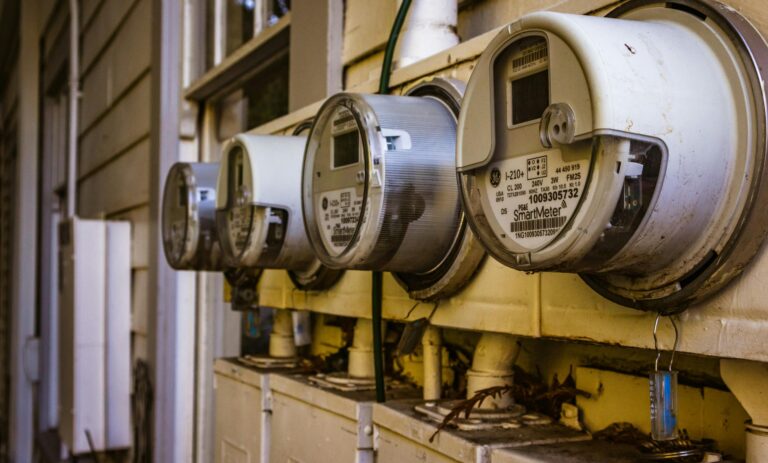
Electricity is one area where both Missouri and Arkansas offer a real advantage over the national average — and it’s one of the most underrated parts of the Ozarks’ cost of living story.
The national average electricity rate is 18.05 cents per kilowatt-hour (kWh). Missouri comes in at about 14 cents per kWh. Arkansas is even lower, at around 11 cents per kWh. If you’re coming from a state like California, where rates can hit 30 cents or more, that difference adds up fast on a monthly bill.
Of course, there are also things you can do to keep bills manageable — good insulation, a modern HVAC system, and programmable thermostats all make a meaningful difference.
Water and trash services in the Ozarks are typically affordable. In many rural areas, you’ll be on a private well and septic system, which means no monthly water bill — just the occasional maintenance cost.
Natural gas is available in larger towns and is generally reasonably priced.
More rural properties may rely on propane, so ask about that upfront when you’re evaluating a home.
To see how your utility costs compare to Arkansas and Missouri’s costs, click here.
Groceries

Missouri’s state sales tax is 4.225%. But groceries are taxed at a state-wide, reduced 1.225% rate.
Then, counties and cities apply their own rates. So, depending on where you’re moving to in the Missouri Ozarks, your effective grocery tax rate could be about 4.5% (in rural areas) to 7% (in the Springfield metro).
And then there’s the good news for Arkansas.
As of January 2026, Arkansas cut its 0.125% state sales tax on groceries. But like Missouri, city and county sales tax on groceries still apply.
Best Places to Live When Moving to the Ozarks
The right town depends on what you’re looking for. Here’s an honest look at the most popular areas.
Branson, Missouri
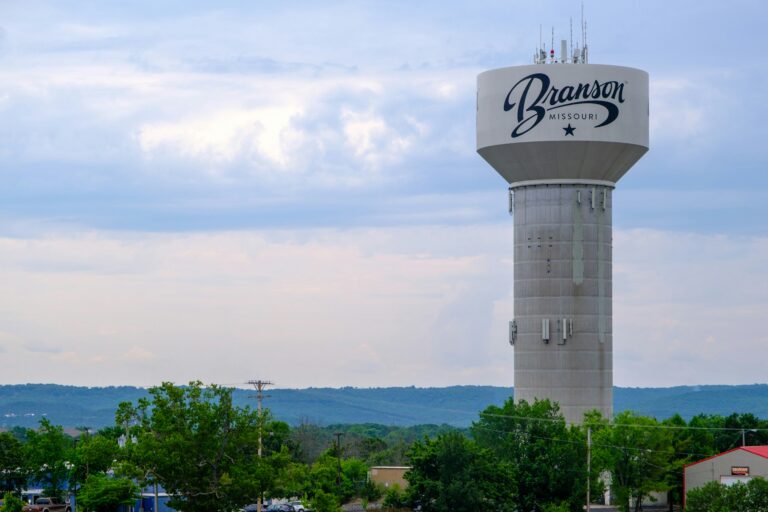
Branson is one of the most well-known towns in the Missouri Ozarks, and for good reason. It sits on the edge of Table Rock Lake with stunning views, top-notch fishing and boating, and a packed calendar of live entertainment and dining. If you’re a retiree or a second-home buyer who wants an active lifestyle without big-city chaos, Branson checks a lot of boxes.
- Best for: Retirees, second-home buyers, outdoor enthusiasts
- Known for: Table Rock Lake, shows, tourism, and scenic beauty
- Home prices: Generally below the national median
Branson is one of our top picks in our detailed article to the best towns in the Ozarks for retirees.
Springfield, Missouri
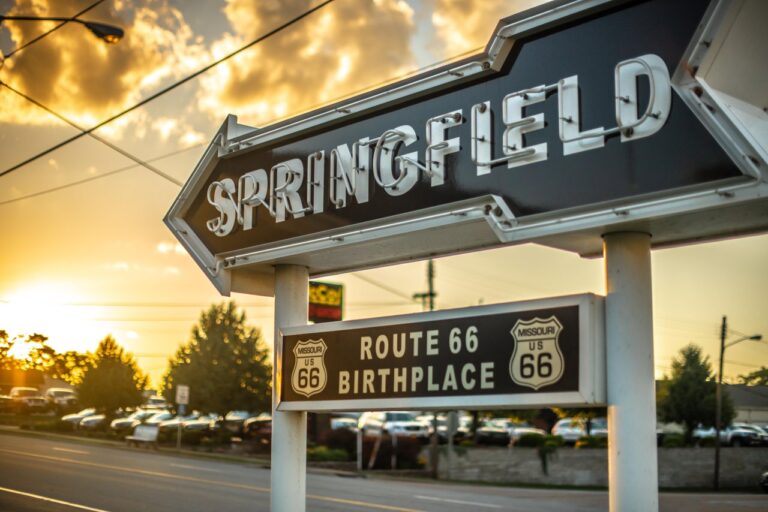
Springfield is the largest city in southern Missouri and the economic hub of the Ozarks. It’s where you go if you want job opportunities, top-tier healthcare, universities, and a restaurant scene — while still being close to the rivers, lakes, and forests the Ozarks are famous for. I think of Springfield as the Ozarks with full amenities.
- Best for: Families, remote workers, healthcare workers, and those who want city conveniences
- Known for: Healthcare, education, dining, and a growing economy
- Home prices: Below the national average, with options at many price points
Remote workers should see our full breakdown of the best Ozarks towns for remote workers, including how Springfield compares.
West Plains, Missouri
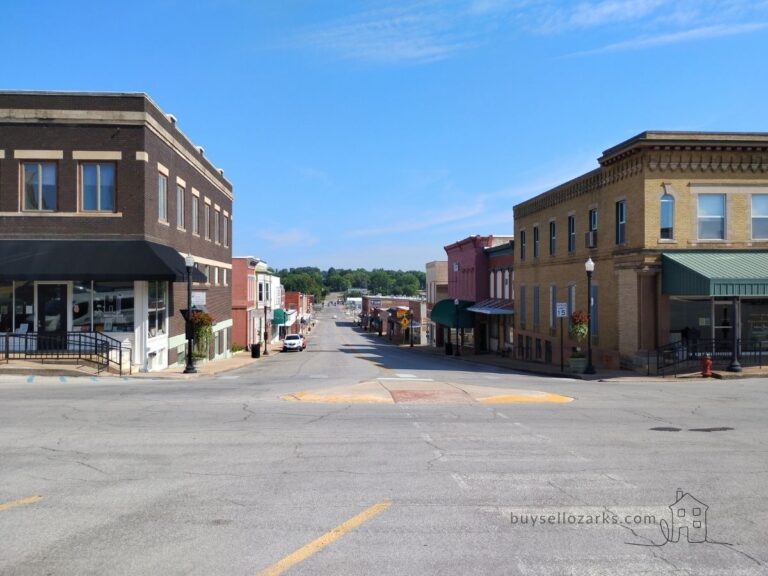
West Plains is a small, tight-knit community in the southern Missouri Ozarks. It’s affordable, quiet, and serves as a regional hub for healthcare, education, and shopping for the surrounding area. The Mark Twain National Forest is practically in the backyard. If you want to get away from it all without giving up basic services, West Plains is worth a serious look.
- Best for: Budget-conscious buyers, retirees, those seeking peace and quiet
- Known for: Affordability, small-town community, access to nature
Mountain Home, Arkansas

Mountain Home sits between two of the best lakes in the Ozarks — Norfork Lake and Bull Shoals Lake — and it’s one of the top retirement destinations in the entire region. The trout fishing on the White River and the North Fork is world-famous. The town is quiet, the people are friendly, and the cost of living is very low.
- Best for: Retirees, anglers, lake lovers
- Known for: Norfork and Bull Shoals lakes, trout fishing, peaceful living
Harrison, Arkansas
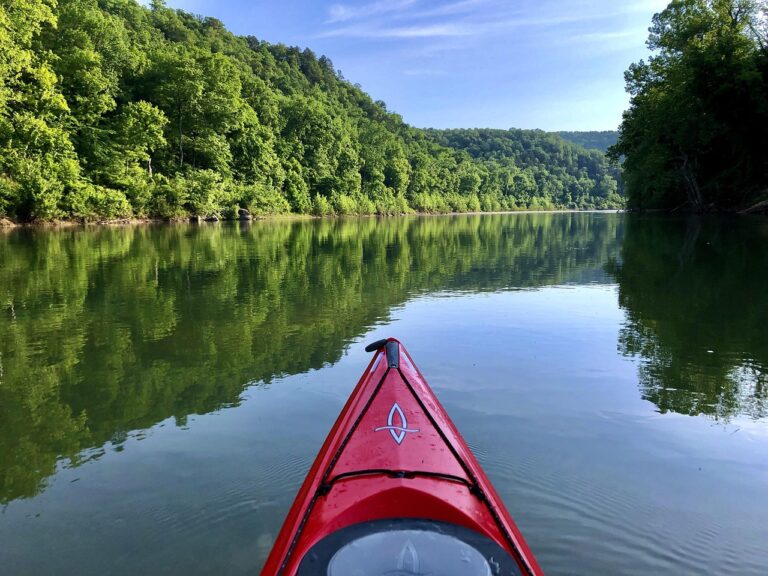
About a 40-minute drive south of Branson is the Harrison, Arkansas. A town of about 13,000, Harrison is known as the “Gateway to the Ozarks.” The Buffalo River — one of the nation’s few remaining undammed rivers — is just outside town. This brings in kayakers and canoers. And for anglers, the Harrison area has great smallmouth bass fishing.
- Best for: Retirees, those who want a town that’s small but big on outdoors activities
- Known for: The Buffalo River, kayaking and canoeing, smallmouth bass fishing
Torn between Missouri and Arkansas? Our Missouri vs Arkansas retirement comparison breaks down taxes, healthcare, and cost of living side by side.
Pros and Cons of Moving to the Ozarks
The Pros of Moving to the Ozarks
- Affordable housing — significantly below the national median in most areas
- Low property taxes — especially in rural counties
- Favorable tax treatment for retirees and veterans in both Missouri and Arkansas
- Stunning natural scenery — rivers, lakes, forests, and rolling hills
- Friendly, welcoming communities
- Less traffic, less noise, and less stress
- Abundant clean water — a real advantage over drought-prone western states
The Cons of Moving to the Ozarks
- Limited job markets in smaller towns — remote work or self-employment helps
- Hot, humid summers — plan accordingly
- Some rural areas have slow or limited internet options — always check before buying
- Healthcare access varies — larger towns are well-served, but rural areas may require travel
- Severe weather in spring — especially thunderstorms and occasional tornadoes, with southwest Missouri counties near Joplin more prone to tornadoes
We go much deeper on the tradeoffs in our full pros and cons of living in the Ozarks breakdown.
What to Know Before Moving
Internet and Cell Service
If you work remotely, this is the first thing to check — not the last.
In cities and larger towns, high-speed internet is readily available. In rural areas, your options may be more limited. Two providers I point people to: Wisper Internet, which offers solid fixed wireless coverage across many parts of the Ozarks. And Starlink, which works almost anywhere and is a reliable option for truly rural properties. But you still need to verify cell coverage at any specific property before you buy.
We cover internet options and cell coverage by area in detail in our full Ozarks internet and cell service article.
Pro tip: Drive to the property and test your phone’s signal. Do it at different times of day. Don’t rely on carrier coverage maps alone.
Healthcare Access

The general rule: larger towns in the Ozarks have solid healthcare.
Springfield in particular is a regional medical hub with Mercy Hospital and CoxHealth Medical Centers. Both hospitals ranked in Newsweek/Statista’s top 20 in the state of Missouri.
And several hospitals in northwest Arkansas made the top state rankings, according to that same study by Newsweek and Statista.
Something to note: In northern Arkansas and southern Missouri, only Springfield has Level 1 trauma centers. So, for life-threatening conditions, patients are airlifted to either Springfield or to Little Rock, home of Arkansas’ only Level 1 trauma center.
Outside of emergencies, smaller and more rural areas may require a drive for specialized care — also something to factor into your decision.
For retirees especially, we break this down by town in our full article: healthcare in the Ozarks.
Climate and Weather
The Ozarks have four real seasons, which is part of the appeal for a lot of people coming from areas with weather extremes.

- Summer: Hot and humid. July and August can be brutal, especially with high humidity. Plan for it.
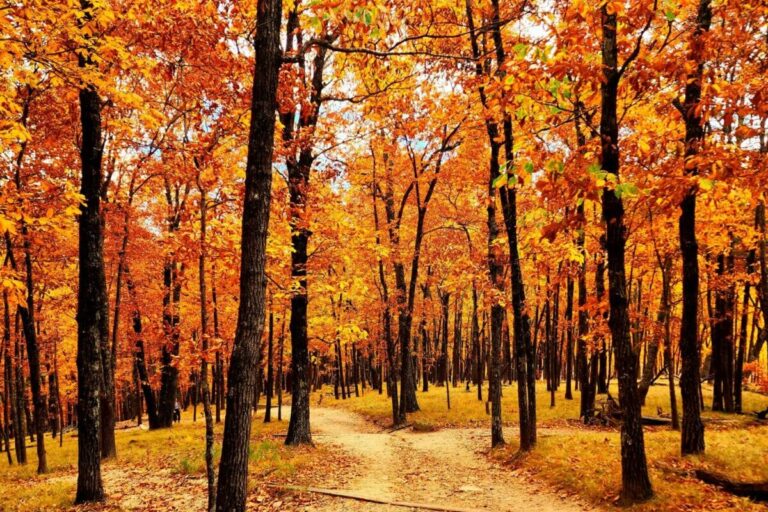
- Fall: Gorgeous. The leaf color in the Ozarks is stunning, and the temperatures are perfect.
- Winter: Mild to cool in most years, with occasional cold snaps. Snow and ice are possible in both southern Missouri and northern Arkansas — especially in January and February. Springfield averages 14 inches of snow per year.
- Spring: Beautiful and green, but also storm season. Thunderstorms and severe weather are most common from April through early June. Again, the far southwest counties of Missouri — especially the Joplin area — see the most tornado risk.
And again — water. The Ozarks are flush with it. It’s worth repeating: Big Spring in Missouri pumps out about 286 million gallons per day. If you’re coming from a state dealing with drought, wildfires, or water restrictions, the Ozarks’ water abundance is one of its most underrated advantages.
Wells, Septic, and Rural Property Basics
Many rural properties in the Ozarks run on private well water and septic systems instead of public utilities. This isn’t a problem — but it’s something to understand before you buy. Always get a well inspection and a septic inspection as part of your due diligence. A good local real estate agent will help you navigate this.
Is Moving to the Ozarks Right for You?
The Ozarks are a great fit if you:
- Want to stretch your dollar further on housing and taxes
- Love the outdoors — fishing, hunting, hiking, boating, or just sitting on a porch by the water
- Prefer a slower, quieter lifestyle
- Are a retiree, veteran, or remote worker who doesn’t depend on a large local job market
- Value community and a sense of place
The Ozarks might not be the best fit if you:
- Need a large metro job market
- Can’t handle hot, humid summers
- Prefer not to deal with bugs — mosquitos, ticks, spiders, and more are abundant, especially in rural areas
- Don’t accept small-town values and a do-it-yourself mindset, which run deep here — people who embrace that tend to love it; those who don’t sometimes struggle to feel at home
These are the exact concerns I built my relocation guides around — finding the right town, understanding what a property actually needs, and avoiding the pitfalls that trip up people who don’t know the region.
Frequently Asked Questions About Moving to the Ozarks in 2026
Is moving to the Ozarks actually affordable in 2026?
Yes, the Ozarks remain one of the most affordable regions in the country. The U.S. median home price is $400,000 in 2026. Arkansas’ median is $240,000. Missouri’s is $270,000. In many rural Ozarks counties, the median price will be even lower. Ozarks property taxes are low, income taxes favor retirees and veterans, and everyday costs are below the national average.
Where do most people moving to the Ozarks choose to live?
It depends on your lifestyle. Retirees and lake lovers tend to land in Branson or Mountain Home. Families and people who want city amenities tend to choose Springfield. Remote workers and corporate professionals often head to northwest Arkansas. People who want true peace and quiet — and the lowest possible cost of living — often end up in West Plains or other smaller Ozarks communities.
What is the cost of living like for those moving to the Ozarks?
Generally below the national average across the board. Housing is the biggest savings. Property taxes are low — sometimes very low in rural areas. Groceries and utilities are close to average. Gas tends to be cheaper than most of the country due to proximity to refineries. Many people who move to the Ozarks find their monthly expenses drop significantly compared to where they came from.
Is the Ozarks a good place to retire?
Yes. Retirees in the Ozarks enjoy low housing costs, very low property taxes, and no state tax on Social Security, military pensions, and VA benefits. Add in the lakes, the fishing, the slower pace of life, and the friendly communities — the Ozarks check nearly every box for retirees. Branson and Mountain Home are especially popular.
What is the weather like in the Ozarks?
Four real seasons. Summers are hot and humid — that’s the one thing most people underestimate. Falls are beautiful. Winters are mild with occasional cold snaps and the possibility of snow and ice. Spring is gorgeous but brings thunderstorms and severe weather, especially in April and May. The southwest corner of Missouri near Joplin is the most tornado-prone area.
Is internet reliable in the Ozarks?
In cities and larger towns, yes — high-speed internet is widely available. In rural areas, it varies. Wisper Internet covers a good portion of the Ozarks and is a reliable, well-priced option. Starlink works well throughout the region and is a strong option for properties where other providers can’t reach. If you’re a remote worker buying a rural property, always verify internet and cell coverage before closing. Don’t assume — check.
Are there job opportunities in the Ozarks?
It depends on where you land. Springfield has a strong job market in healthcare, education, and business. Northwest Arkansas has a robust corporate economy anchored by Walmart and its supplier network. Smaller towns have more limited options. Some people moving to the Ozarks today are retirees, remote workers, or self-employed — so the local job market matters less to them than it used to. If you need a local job, Springfield and northwest Arkansas are your best bets.
Go Deeper
Remote Workers
- Remote Salary in the Ozarks
- Best Ozarks Towns for Remote Workers
- Internet in the Ozarks for Remote Workers
- Buying a Home in the Ozarks
Retirees
- Retiring in the Ozarks: Why It’s the Smart Choice
- Best Towns in the Ozarks for Retirees
- Healthcare in the Ozarks for Retirees
- Missouri vs Arkansas Retirement
Veterans
- Life After the Military in the Ozarks
- Ozarks Communities for Veterans
- VA Loan in the Ozarks
- USDA Loan in the Ozarks
Final Thoughts

Moving to the Ozarks can change your life — for the better. I know because it changed mine. Lower costs, cleaner air, cleaner water, better access to nature, and a community that still feels like a community.
But the Ozarks aren’t magic. The right outcome depends on choosing the right town, the right property, and going into it with clear eyes. That’s where I come in.
I know the region, I know the market, and I know the pitfalls people run into. This site — and the Starter Kit below — is built to pass that along.
📩 Get the Free Ozarks Relocation Starter Kit
I put together this free email series because it’s what I wish I’d had when I was doing this research myself.
You won’t find this in a generic Google search or a typical relocation guide. This is on-the-ground knowledge from someone who’s worked as a real estate agent in this region and made this move myself.
Plus, you get a location fit score and a fun, interactive town-for-you quiz — yours whether we ever work together or not.
I believe the Ozarks is one of the best places to plant roots. And I want to make sure you have everything you need to find the right fit for you and your family.
Recent Articles
-
6 Ways to Save Money When Mortgage Rates are High in Springfield, MO
Got the high mortgage rate blues? This article shows 6 ways to save money when mortgages rates are high, so you can buy that house you want in Springfield, MO.
-
Springfield vs Branson, Missouri: Two Ozarks Housing Markets, Two Fall Strategies
Springfield’s median home sold in 15 days vs 67 days for Branson. Here’s what the numbers mean for fall buyers & sellers in the Springfield vs Branson housing market.
-
Ozarks Home Buyers: How to Save Money on Closing Costs
Buying an Ozarks home and want to save money on closing costs? VA, FHA, and conventional loans have different seller concessions limits. Find out how to save money in this article.